
Building Management Systems
Building Management Systems (BMS) are integrated control solutions designed to monitor, manage and optimize building operations such as HVAC, lighting, energy, fire safety, access control and other critical infrastructure. BMS centralizes data from multiple subsystems, enabling efficient control, automation and real-time monitoring to ensure comfort, safety and operational efficiency.
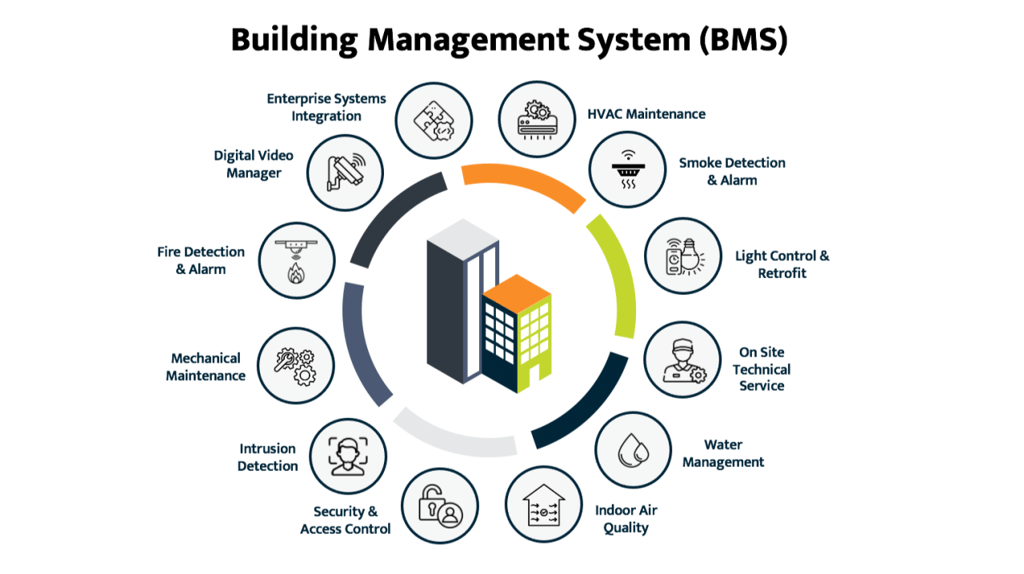
BMS improves energy efficiency, occupant comfort, safety and operational reliability. It allows building operators to monitor systems remotely, detect faults early, schedule maintenance and automate responses to changing conditions. Integration with fire alarms, access control, CCTV, and public addressing systems enhances coordinated responses during emergencies. BMS supports data-driven decision-making, cost optimization and sustainability initiatives. BMS can be scalable and modular, allowing future expansion and integration of new technologies.
BMS has to comply with local building codes, energy efficiency standards, electrical and fire safety regulations and relevant international standards. ISO 50001 for energy management. Regulations has to cover sensor installation, system reliability, data security and interoperability with safety-critical systems. Regular audits, calibration and reporting ensure compliance and operational safety.
Implementation involves site assessment, system design and selection of sensors, controllers and software platforms.
Installing sensors, actuators and controllers for HVAC, lighting, energy and security systems.
Configuring centralized BMS software or dashboards for monitoring and automation.
Integrating subsystems like fire alarms, access control, CCTV and PA systems for unified control.
Conducting testing, commissioning and user training, followed by ongoing maintenance and software updates.
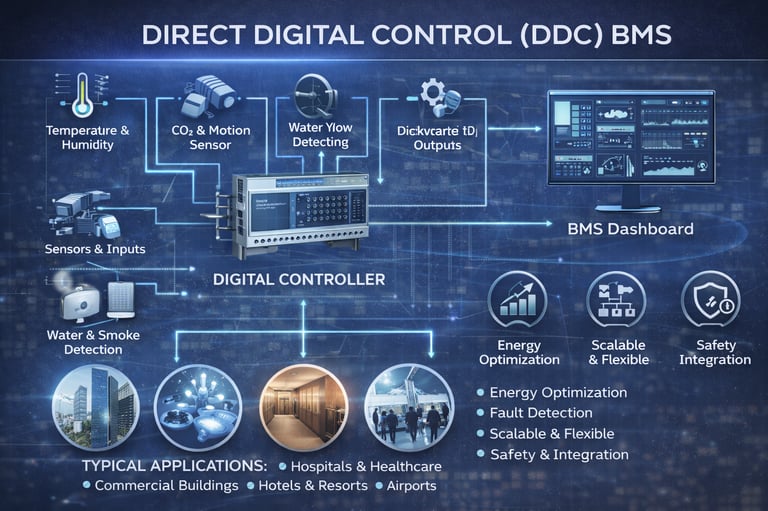
DDC BMS is a modern building automation system that uses digital controllers, sensors and actuators to continuously monitor, control and optimize building subsystems such as HVAC, lighting, energy management and safety systems. Unlike legacy analog systems, DDC allows precise, automated control through programmable logic and real-time digital communication.
Digital Controllers: Programmable units that receive sensor input and manage outputs to actuators.
Sensors & Inputs: Temperature, humidity, CO₂, motion, water flow, pressure, energy meters, smoke and leak detection.
Actuators & Outputs: Control devices for dampers, valves, fans, pumps, lighting circuits and other building equipment.
Centralized Management: Data from all controllers is sent to a centralized BMS software/dashboard, providing real-time monitoring, alarms, scheduling and reporting.
Integration: Works seamlessly with fire alarms, access control, CCTV, PA systems, elevators, and other building subsystems.
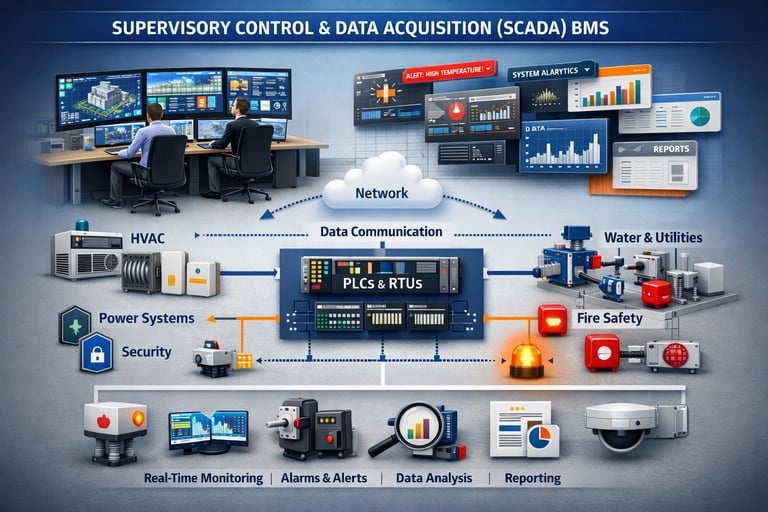
Supervisory Control and Data Acquisition (SCADA) BMS is an advanced building and infrastructure management system designed for centralized monitoring, supervisory control and data analysis of large, complex and mission-critical facilities. SCADA systems collect real-time data from multiple subsystems and enable operators to supervise operations from a unified control platform.
SCADA BMS is particularly effective in environments where continuous uptime, high reliability and real-time visibility are essential. It integrates data from HVAC, electrical systems, power distribution, water management, fire safety, security systems and industrial processes, presenting actionable insights through graphical dashboards, alarms and trends.
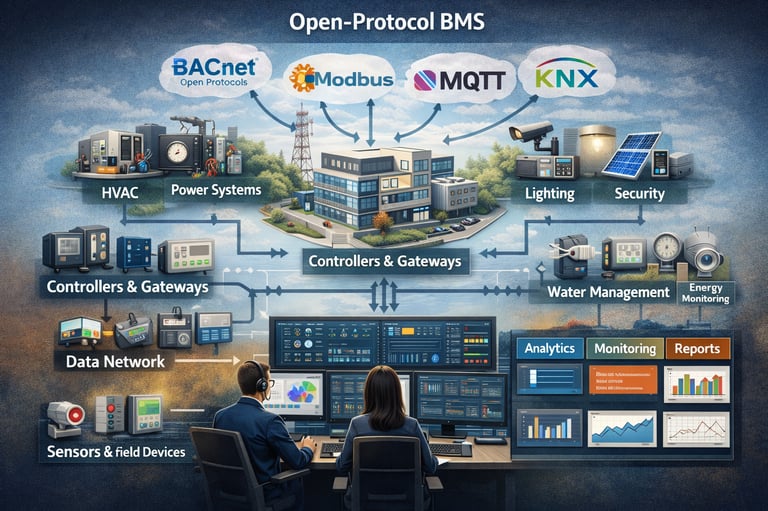
Open-Protocol BMS are building automation platforms designed to integrate and manage multiple building systems using non-proprietary, industry-standard communication protocols. These systems enable seamless interoperability between equipment and controllers from different manufacturers, ensuring flexibility, scalability and long-term system viability.
Open-Protocol BMS commonly support standards such as BACnet, Modbus, KNX, MQTT, OPC and LonWorks, allowing HVAC, lighting, power monitoring, water management, fire systems, security, and energy management to operate under a unified supervisory platform. This approach eliminates vendor lock-in and simplifies future system expansion or upgrades. Real-time data is visualized through dashboards, alarms, trends, and reports, enabling operators to monitor performance, detect faults, and optimize building operations efficiently.
Contact Us
Reach us anytime for support / Queries / Clarifications
Protexa support
info@protexa.in
+91 9743 913 433
© 2026. PROTEXA, all rights reserved.
Have a question
+91 7411 265 539
support@protexa.in
No 99/2, Sudersan Layout, Garvepalya, Bangalore South, Bangalore, Karnataka, 560068
www.protexa.in